Checkout-Free Shopping: How REWE Pick & Go Really Works in Cologne
I spent a long weekend in Cologne recently. It was a really nice trip, especially because people were relaxed and friendly. Cologne also feels pleasantly manageable compared with Berlin: it rarely took me more than 30 minutes to get anywhere. A nice change of pace.
But something else really caught my attention: a REWE supermarket using a Grab & Go concept. The idea is simple: put the products straight into your own bag, scan a QR code from the app as you leave, and the system has already identified which items you took. No checkout, no scanning individual products, and no waiting.
The system is called REWE Pick & Go and is available, among other places, at the store at Luxemburger Straße 150 in Cologne-Lindenthal. Afterwards, I looked into how this could work from a technical perspective, and that is what this article is about.
A note before we begin: For understandable reasons, REWE and its technology provider, Trigo, publish few details about the exact technical implementation. After all, it is a trade secret. Much of what I write below about the system’s specific technical operation is therefore my own interpretation and speculation, based on publicly available information, the general state of the art in computer-vision research, and a few statements made by Trigo itself. Wherever I have a reliable source and can be confident about a detail, I make that clear.
What is behind the concept?
The basic idea is easy to describe: walk in, pick up products, walk out and the checkout system still knows what you bought. At the entrance, you scan the QR code from the Pick & Go app. Your payment method Apple Pay, Google Pay, PayPal, or a credit card is linked to the app. Everything you take from the shelves while shopping is automatically added to a virtual basket. When you leave through the exit gate, the basket is charged automatically, and a digital receipt appears in the app.
The Cologne store still has traditional checkouts and self-checkout terminals, by the way. You can choose whether to pay the usual way or use Pick & Go.
As far as I could establish, the system relies on three components working together:
Component 1: Weight sensors in the shelves
Every shelf is equipped with sensors that continuously measure weight. When you remove a product, the sensor immediately registers the change. The useful part is that the sensor does not just detect that something has been taken; it can also signal when a product is picked up briefly to be looked at and then put back in other words, when no purchase takes place. Without this information, the software would have to infer purchase intent from camera footage alone, which would be considerably more error-prone.
Component 2: Ceiling-mounted cameras
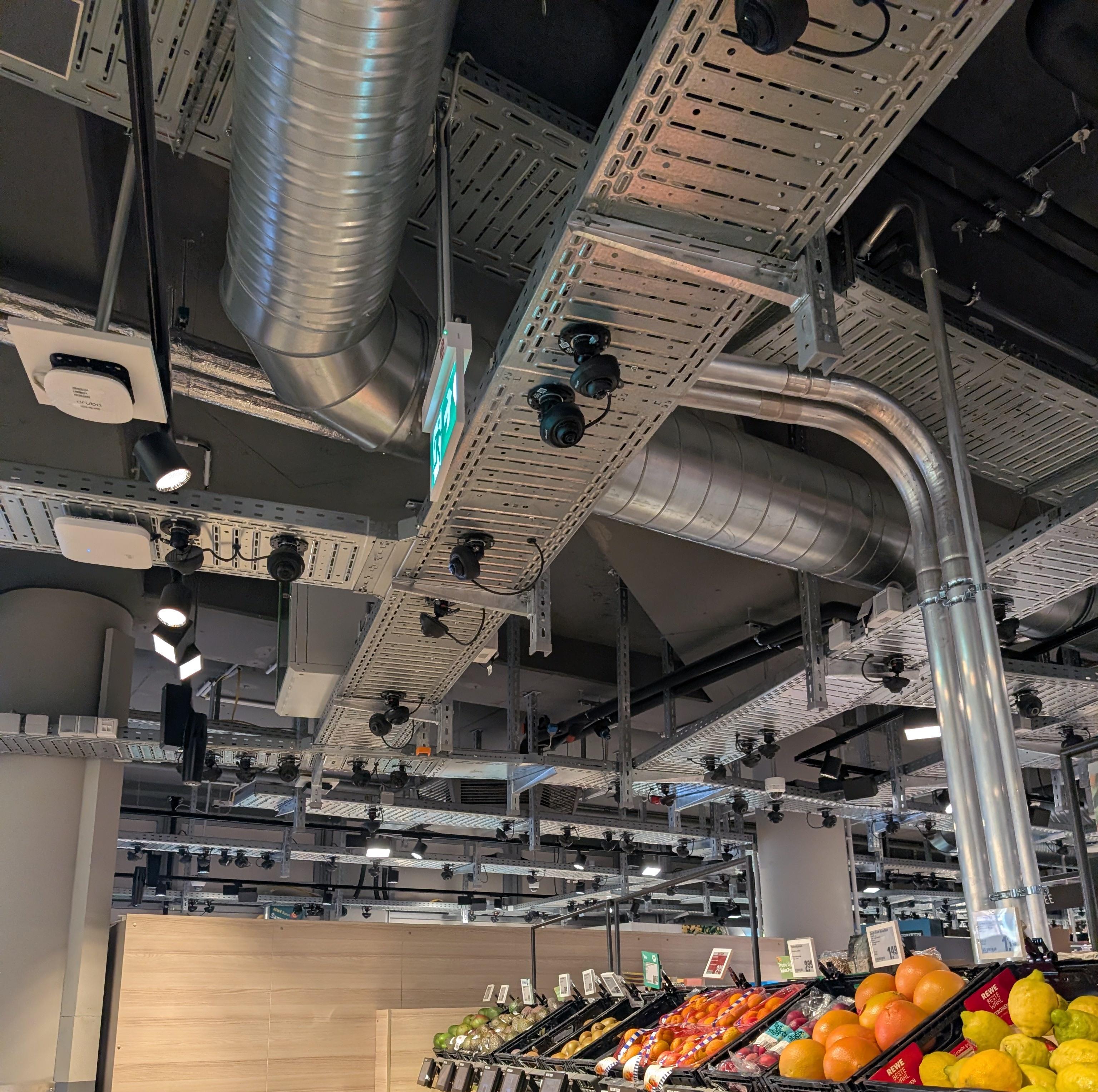
A large number of cameras are mounted throughout the sales area. Comparable stores are said to have several hundred in some cases. They continuously capture the aisles and shelf areas. One important point: REWE explicitly states that it does not use facial recognition. Instead, customers are tracked using other, non-biometric characteristics, such as body shape, clothing, movement patterns, or their position in the store. According to REWE, these tracking data are deleted after the shopping trip, so the system should not recognize you again on a later visit.
Component 3: Computer vision / AI
The system’s actual “intelligence” is software that uses camera footage and sensor data in real time to work out which person is associated with which shelf interaction and then build a virtual shopping basket.
The technology behind it: Trigo
The technology partner behind REWE Pick & Go is the Israeli company Trigo, sometimes also referred to as “Trigo Vision.” REWE is not only a customer but has also invested in Trigo to help further develop the technology for the German market.
Trigo describes its system as a camera-based, AI-powered platform that uses standard ceiling cameras and sensors to create a digital representation of a store and track the position and movement of objects including customers. Trigo repeatedly emphasizes that the system works with existing, off-the-shelf CCTV cameras and does not require specialized hardware such as depth cameras or LiDAR. This suggests that the real achievement is not exotic hardware, but software that combines feeds from many ordinary cameras into a consistent picture of what is happening in the store.
How might the technology work? (Speculation and interpretation)
This is where things become speculative. From this point on, I am describing how a system like this would probably work based on the general state of the art not what is specifically installed in the shelves in Cologne.
Recognizing people without recognizing their faces. The relevant field of computer-vision research is called person re-identification (Re-ID for short). Instead of identifying someone by their face, the system uses a combination of other characteristics: clothing colors and patterns, body proportions, gait, direction and speed of movement, position in the store, which hand they are using, or which products are already in their virtual basket. No single characteristic is unique on its own, but combining them could make it possible to match a person with a high degree of probability.
The problem of occlusion. If someone briefly walks behind a tall shelf and disappears from a camera’s view, the system later has to decide whether the person who reappears is the same one. It would probably combine factors such as the person’s last known position, plausible routes through the store, the time elapsed, and their appearance. Since the fields of view of many ceiling cameras overlap, there are probably few genuinely “blind spots” in practice; usually, at least one other camera can still see the person.
When two people look alike or cross paths. If two customers happen to wear similar clothes or cross paths in an aisle, the system could theoretically confuse them. Systems of this kind probably use so-called multi-object trackers to follow each person continuously and recalculate the most likely match with every new frame. Combining this with the precise timestamp of a shelf-sensor event could reduce uncertainty considerably.
Sensor fusion is probably the real trick. My personal assessment is that the real “secret” behind systems like this lies less in basic object recognition which modern AI models can handle quite well and more in combining dozens of camera streams and sensor readings so that the system can reliably associate one person with one product throughout the entire shopping trip, without errors accumulating along the way.
What is actually confirmed and what isn’t?
I did not want to rely on speculation alone, so I looked into what Trigo has actually published. One of the most useful sources I found was a technical article published in 2020, written by Trigo’s own machine-learning engineers for the official PyTorch blog.
The article supports the following conclusions with a high degree of confidence:
- PyTorch is the deep-learning framework Trigo used to develop its models. The engineers cite benefits including easier debugging and flexibility when building complex neural networks.
- To manage training runs and experiments, Trigo used Allegro AI Trains, the predecessor of today’s ClearML. It can be used to version and compare training runs and deploy them as containers automatically.
- According to the article, the architecture consists of several specialized AI models, including models for object detection, tracking, and pose estimation. A higher-level logic layer combines their outputs into a single decision. This is comparable to sensor fusion in an autonomous vehicle, where lane detection, obstacle avoidance, and GPS data feed into a shared decision-making process.
- In a separate guest article, one of Trigo’s chief architects also mentions the use of Google Cloud and BigQuery for training and scaling.
- For day-to-day operation in stores, Trigo describes an approach designed to minimize latency by processing data largely on-site in an on-premises cluster. In other words, inference the real-time recognition itself does not take place only in a remote data center; it happens directly in the store.
One qualification is important: the article cited above dates from 2020 and describes the development pipeline at that time. I cannot say for certain whether exactly the same tools are still being used in the same way six years later, or whether they are used in the Cologne store. For specific components such as object-detection libraries (for example, YOLO or comparable models) and the underlying Re-ID algorithms, I could not find a reliable public source. Those details therefore remain speculation based on the general state of the research.
What about data privacy?
Understandably, a store full of cameras can feel a little unsettling at first. REWE explicitly states that:
- There is no facial recognition.
- Image analysis is intended solely to enable shopping without the usual scanning process.
- Personal movement data are supposed to be deleted after the shopping trip, which should prevent the system from recognizing a customer during a later visit.
As a customer, of course, I cannot assess how these claims can be verified in detail. Ultimately, it comes down to trust in REWE and Trigo.
Conclusion
As a visitor, I found the shopping experience impressively uneventful. In everyday use, you barely notice how much technical work is going on in the background just so you can put products in your bag and walk out. That is also what makes the system so interesting: a supermarket visit that feels completely ordinary is probably powered by hundreds of cameras, thousands of shelf sensors, and an AI pipeline that continuously works out who has put what into their bag. I am curious to see whether and how systems like this will spread to more cities over the next few years.
Further reading
- heise.de: Testing checkout-free supermarket shopping
- heise.de: Pick & Go REWE enables checkout-free shopping in supermarkets
- FOCUS: What fully automated supermarkets mean for the future of shopping
- EXPRESS: REWE’s new checkout system and camera monitoring
- stores+shops: Interview about Grab & Go technology at REWE
- Trigo